BMW Celebrates Production of Three-Millionth Electrified Vehicle as EV Expansion Accelerates
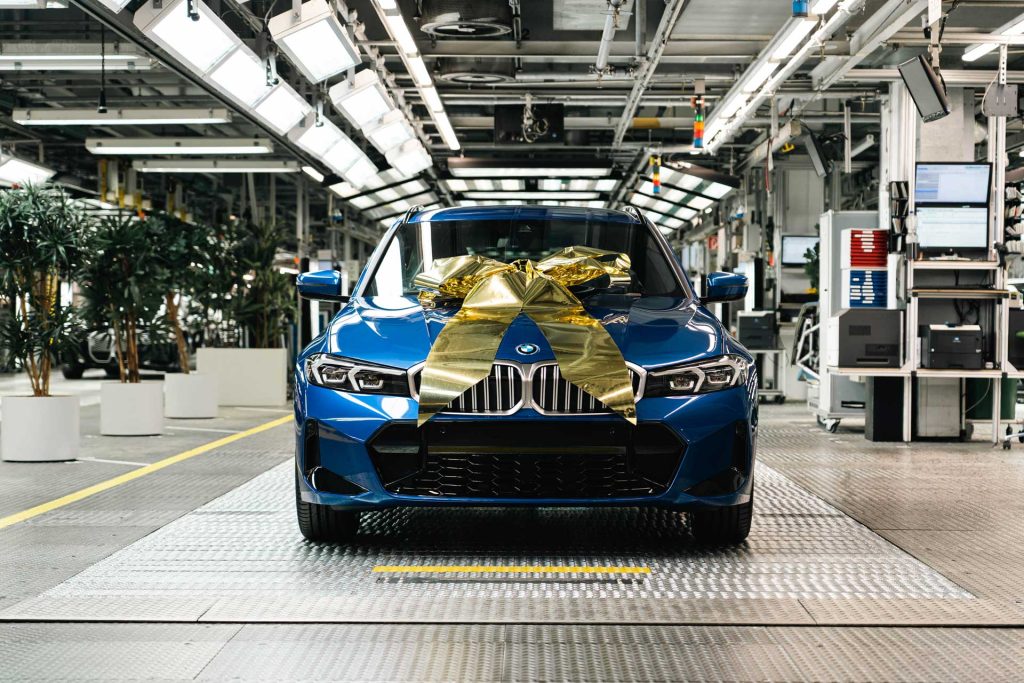
BMW has hit a significant production milestone this week, as the three-millionth electrified vehicle rolled off the assembly line at its main plant in Munich. The landmark car, a BMW 330e Touring in Portimao Blue, is destined for the UK market, highlighting the growing importance of plug-in hybrids and fully electric vehicles (EVs) to the company’s global strategy.
The vehicle’s completion marks a decade of progress in BMW’s electrification journey, which began with the launch of the BMW i3 in 2013. Now, in 2024, one in four BMW vehicles sold is either fully electric or a plug-in hybrid – a figure expected to rise further as the company scales up production of zero-emission models.
“With its highly flexible production, the BMW Group is able to respond to customer requirements in line with market trends and demand,” said Milan Nedeljković, BMW Group Board Member for Production. “All plants in our global production network are enabled for electromobility, paving the way for continued growth in this segment.”
Seamless Integration of EV and ICE Production
BMW’s production philosophy allows electric, hybrid, and combustion engine vehicles to be assembled on the same production lines. This flexibility has enabled the manufacturer to adapt quickly to market shifts without the need to segregate production operations.
Initially, the fully electric BMW i3 was manufactured in a dedicated facility within the Leipzig plant. Over time, BMW has transitioned towards an integrated model, with electric vehicles now produced at all BMW Group sites worldwide. In 2024, electrified models made up over 25% of the company’s total production volume, with three-quarters of those being fully electric.
Global Footprint for Electric Production
The company has strategically expanded its BEV (battery electric vehicle) output across the globe. The MINI Cooper SE began production in Oxford in 2019, and more recently, the BMW iX3 has been built in China, while the iX and i4 models were launched from Dingolfing and Munich in 2021.
By 2022, all BMW Group facilities in Germany were capable of producing fully electric models. This includes Plant Leipzig, which also assembled BMW’s first plug-in hybrid sports car, the i8.
Globally, BMW is advancing its electrification efforts:
-
China: All BMW plants already produce electrified models.
-
USA: Plant Spartanburg will begin BEV production in 2026.
-
Mexico: San Luis Potosí will start building NEUE KLASSE BEVs in 2027.
-
South Africa: Rosslyn began plug-in hybrid production in 2024.
-
Brazil, India, and Thailand: All have local assembly of electrified vehicles.
E-Drive Manufacturing and Future Development
BMW’s push into electromobility also includes the development of its own electric drivetrain components. The Competence Centre for E-Drive Production in Dingolfing has played a crucial role since the i3’s launch, producing electric motors and high-voltage battery modules. By 2022, it had ramped up to over 500,000 e-drives annually.
The production of fifth-generation e-drive systems is now taking place across several facilities, including Dingolfing, Regensburg, Leipzig, and Spartanburg. These advancements will culminate in the release of BMW’s sixth-generation e-drives at its brand-new plant in Debrecen, Hungary, later this year, as part of the eagerly anticipated NEUE KLASSE rollout.
This latest milestone underlines BMW’s strong positioning in the rapidly evolving automotive landscape, blending innovation, flexibility, and global scale to meet growing demand for low- and zero-emission vehicles.
CO2 EMISSIONS & CONSUMPTION.
BMW 330e xDrive Touring: Energy consumption, combined: 24,4 kWh/100 km and 1,2 l/100 km (WLTP); CO₂ emissions, combined: 26 g/km (WLTP); CO₂ class(es): with discharged battery G; weighted, combined B; fuel consumption with discharged battery: 8,3 l/100 km (WLTP).
Source: BMW