Ford Ranger Super Duty Enters Race for UK Military Vehicle Contract
Lisa Baker, Editor September 2, 2026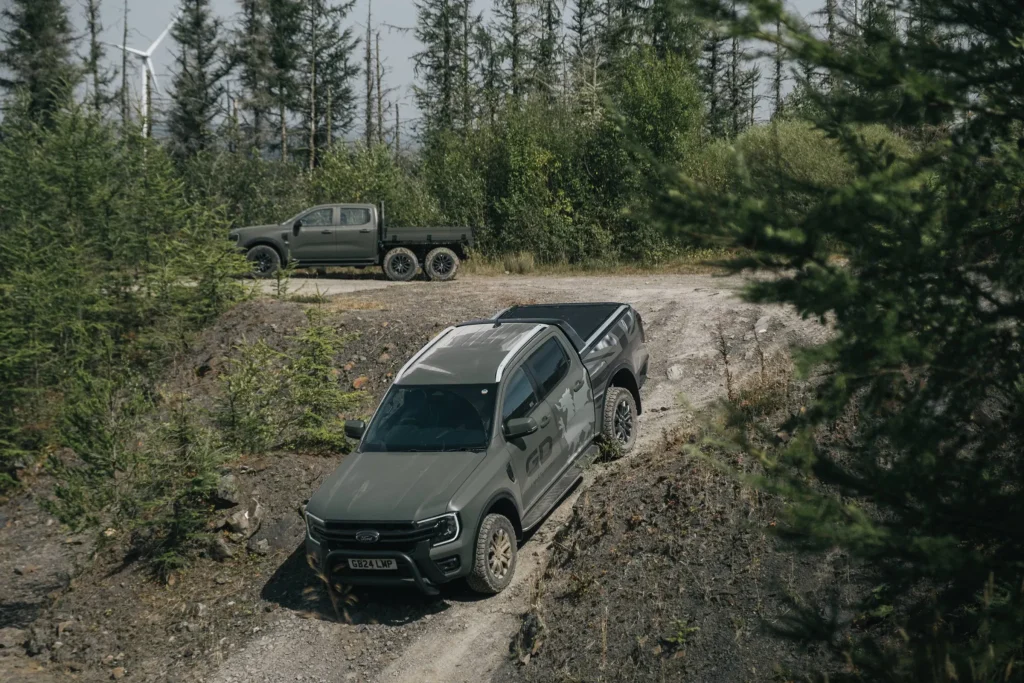
The partnership is proposing a military mobility solution based on the Ford Ranger and heavy-duty Ranger Super Duty, combining extensively tested commercial vehicles with specialist defence engineering and long-term support.
Ford argues that adapting a high-volume commercial platform could help Britain replace ageing military vehicles more quickly than commissioning an entirely bespoke model. It would also give the Armed Forces access to established production facilities, readily available components and an existing service network.
The company believes this approach could offer an important advantage as European governments seek to modernise their vehicle fleets while responding to rapidly changing operational requirements.
Unlike traditional low-volume defence programmes, a commercial platform can draw upon production capacity spread across multiple factories. Common mechanical components could also simplify driver training, maintenance and the supply of replacement parts throughout a vehicle’s operational life.

Ford Highlights Its UK Manufacturing Footprint
Although the Ranger is a global product, Ford says its substantial British manufacturing and engineering operations would support the proposed military fleet.
The company currently employs more than 6,000 people around the country and has operated in Britain for over a century.
Its Dagenham plant in Greater London manufactures the 3.0-litre V6 diesel engine used by the Ranger Super Duty, alongside two other diesel engine lines. Dunton is home to Ford’s global commercial vehicle engineering, technical development and conversion-design activities.
Daventry operates as the company’s central parts and logistics hub, while Halewood manufactures advanced electric powertrains and e-drive systems.
Ford says this domestic presence, supported by its nationwide dealer and mobile servicing network, could give the Ministry of Defence access to established maintenance expertise and a resilient supply of replacement parts from the beginning of the programme.
Jim Baumbick, president of Ford in Europe, said:
“Stepping up when our nations call is in Ford’s DNA.”
The company pointed to its historical contribution during the Second World War, when its factories in Dagenham and North America produced vehicles and engines for the Allied war effort.
Ford also highlighted its manufacturing response to the Covid-19 pandemic, during which it says production facilities were adapted to help make more than 22 million face shields, 50,000 ventilators and 32,000 respirators.

A Commercial Vehicle Adapted for Defence
The Ranger is manufactured at five plants across four continents and sold in more than 180 markets. Ford also describes it as Europe’s best-selling pick-up for 11 consecutive years.
That commercial scale is central to the company’s argument for using the Ranger as the foundation for a future military vehicle.
Ford says production could be adjusted across its global manufacturing network to meet changes in demand, potentially avoiding some of the delays associated with specialist vehicles built in relatively small numbers.
A common underlying architecture could also allow different military variants to share components. This may reduce the number of parts that must be held in stock while making vehicle training and maintenance more consistent across the fleet.
The standard Ranger has received a five-star Euro NCAP safety rating. Although military adaptations would introduce different operating requirements, Ford believes the production vehicle’s occupant protection and driver-assistance systems provide a strong starting point for routine transport, training and operational duties.
General Dynamics Land Systems UK and Ricardo would contribute their respective defence, systems-integration and specialist engineering experience. The three companies say their proposal is intended to provide more than a vehicle, covering its conversion, supply, maintenance and development throughout its working life.
Ranger Super Duty Brings Heavier Capability
At the centre of the proposal is the Ranger Super Duty, a more capable derivative designed for demanding commercial and specialist applications.
It can carry a payload of up to 1,982kg and tow as much as 4.5 tonnes, depending on vehicle configuration and operating conditions. Its gross train mass reaches eight tonnes.
Power comes from the Dagenham-built 3.0-litre V6 turbodiesel engine, producing 209PS and 600Nm of torque.
The mechanical specification includes locking front and rear differentials, a heavy-duty transfer case and upgraded suspension. Almost 300mm of ground clearance is complemented by extensive steel underbody protection intended to shield critical components on difficult terrain.
Ford also quotes an 850mm maximum wading depth, providing scope for the vehicle to cross substantial water obstacles.
These capabilities could allow the Ranger Super Duty platform to support a variety of military applications. Depending on the final configuration and Ministry of Defence requirements, possible roles could include personnel transport, command and communications duties, logistics support or the carriage of specialist equipment.

Five Million Kilometres of Testing
Ford says the Ranger Super Duty underwent almost five million kilometres of testing across five continents before production.
Development vehicles were operated in temperatures ranging from minus 40°C in the Arctic to 50°C in the Australian Outback. Testing also included simulated 10-year working cycles conducted inside specialist monsoon chambers.
The pick-up was subjected to Silver Creek, one of Ford’s most punishing durability courses in Australia. Robotic drivers were used for repeated testing because the continual shock loads mean human drivers are limited to a single run each day.
Other trials involved repeatedly driving development vehicles through deep clay until they accumulated as much as 600kg of mud. Engineers used those tests to assess cooling performance, suspension geometry and resistance to corrosion while the vehicle was carrying a substantial additional weight penalty.
While demanding commercial testing does not by itself qualify a vehicle for military service, Ford says the resulting durability data gives its partners an established engineering base from which to develop the required defence variants.
Commercial Scale Could Shape Future Military Fleets
The Ford-led bid reflects a wider debate about how quickly armed forces can acquire new vehicles without sacrificing capability or long-term reliability.
Purpose-built military vehicles can be developed around highly specific requirements, but bespoke programmes may involve long lead times, limited production volumes and specialist supply chains.
Commercially derived vehicles offer a different balance. They can draw on existing manufacturing capacity and widely established parts networks, although they must still be modified and tested for the more demanding conditions associated with military use.
Ford’s proposition is that the Ranger Super Duty can combine both approaches: the scale and support infrastructure of a global commercial pick-up with specialist modifications delivered by experienced British defence and engineering partners.
The Ministry of Defence will ultimately determine whether that combination meets the requirements of its Light Mobility Vehicle programme. If successful, however, the bid could place a familiar name from Britain’s roads at the foundation of the Armed Forces’ next generation of light vehicles.