Latin America Passes 10,000 Electric Buses As Cities Unlock Billions In Clean Transport Investment
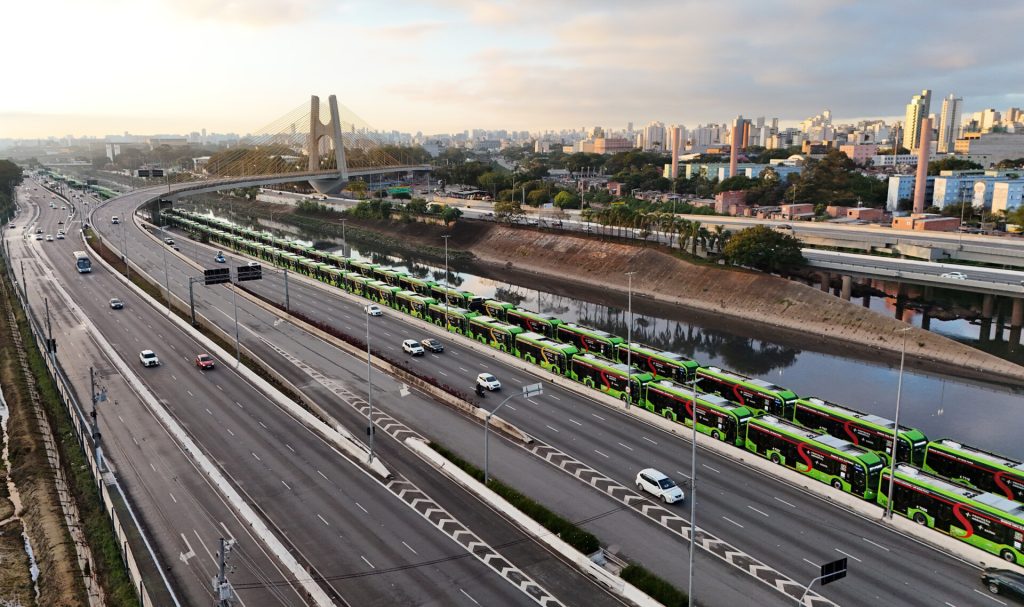
Latin America’s electric transport market has reached a significant new milestone, with more than 10,000 electric buses now operating across the region as cities increasingly turn to innovative financing models to fund the transition away from diesel.
More than 80 cities across 13 countries are now operating electric buses, according to consolidated data from E-Bus Radar, announced by C40 Cities and the International Council on Clean Transportation (ICCT) during Lat.Bus 2026, the region’s largest transport and mobility event.
The figures illustrate how electric public transport is developing into a sizeable infrastructure and investment market across Latin America, with governments, development banks, international institutions and private suppliers increasingly involved.
Santiago, São Paulo and Bogotá alone now operate more than 7,000 electric buses between them.
São Paulo has emerged as the region’s second-largest electric bus market and the largest in Brazil, demonstrating how public finance, international capital and regulation can be combined to deliver fleet electrification at scale.
Across Latin America, the 10,000 electric buses are estimated to prevent more than 10 million tonnes of CO2 emissions annually.
From Climate Policy To Major Infrastructure Market
The shift has potentially significant implications for businesses operating across transport manufacturing, batteries, charging technology, electricity infrastructure, finance and fleet management.
Electrifying thousands of buses requires considerably more than replacing individual vehicles. Cities must develop charging facilities, upgrade depots, secure electricity supplies, restructure procurement arrangements and find ways of funding large upfront capital requirements.
In Brazil, some of that work is being accelerated through initiatives including the ZEBRA Alliance and the Mutirão Brazil Programme, a joint initiative involving C40 Cities and the Global Covenant of Mayors for Climate & Energy.
Since 2019, C40 Cities and the ICCT, through the ZEBRA Partnership and alongside other partners, have worked with São Paulo, Bogotá, Mexico City, Salvador and Curitiba on developing and structuring financing models.
The organisations say the collaboration has helped connect municipal authorities with financial institutions and suppliers, reduce the cost of capital and unlock large-scale purchasing of zero-emission vehicles.
Ilan Cuperstein, C40 Cities Regional Director for Latin America, said:
“Reaching 10,000 electric buses in operation shows that the transition to zero-emission transport is no longer a promise but a reality in Latin American cities. What was once the exception is now an expanding public policy, delivering direct benefits for the climate, health, public transport quality and local economies. The message to other cities is clear: financing does not have to be a barrier. Tested pathways exist, and the network is ready to support those willing to take them.”
São Paulo Builds R$6.5 Billion Investment Programme
São Paulo provides perhaps the clearest example of the financial scale involved in the transition.
In June 2026, the city introduced 500 new electric buses in a single deployment, taking its total electric fleet to 1,759 vehicles.
That comprises 1,570 battery-electric buses and 189 trolleybuses.
The fleet is estimated to prevent approximately 130,000 tonnes of CO2 emissions each year while eliminating the need for around 57 million litres of diesel.
São Paulo has supported the transition through an investment programme worth approximately R$6.5 billion, drawing together domestic and international finance.
Institutions involved include the Brazilian Development Bank (BNDES), the World Bank and the Inter-American Development Bank (IDB).
The financing structure is significant because the upfront cost of moving from conventional buses to electric fleets remains one of the principal obstacles facing municipalities internationally.
São Paulo’s approach provides one possible model for overcoming that barrier by combining public policy with multiple sources of finance rather than requiring municipal budgets to carry the entire initial cost.
Diesel Replacement Restricted As City Accelerates Transition
Regulation is providing another component of São Paulo’s strategy.
Under municipal rules, operators can no longer replace vehicles reaching the end of their working lives with new diesel buses.
The policy effectively builds the energy transition into the normal vehicle replacement cycle, progressively increasing the proportion of low- and zero-emission vehicles in the city’s fleet.
The municipal transport network carries more than seven million passengers each day, giving electrification the potential to influence both emissions and air quality on a substantial scale.
Ricardo Nunes, Mayor of São Paulo, highlighted:
”We are accelerating the energy transition of the country’s largest city and consolidating a public policy that is already a national and international benchmark. Through a single delivery of 500 new electric buses in June, the city achieved the environmental equivalent of planting 3.2 million trees per year. This avoids the emission of 45,000 metric tons of CO₂ while cutting annual diesel consumption by approximately 20 million litres.”
Other Brazilian Cities Follow São Paulo’s Lead
São Paulo is far from alone in pursuing electric transport.
Salvador, Recife, Belo Horizonte and Rio de Janeiro are among the Brazilian cities progressing electrification projects with assistance from C40 and other members of the ZEBRA Alliance.
The programmes also illustrate the investment opportunities being created beyond vehicle manufacturing itself.
In Rio de Janeiro, work is under way to prepare terminals within the Rio transport system for future electric buses. This includes charging infrastructure studies, economic and financial modelling and project structuring.
Salvador is receiving support aimed at electrifying at least half of its BRT fleet.
Recife, meanwhile, has secured a R$319 million investment from Brazil’s Federal Government for the acquisition of 100 electric buses and associated charging infrastructure for the metropolitan region.
Brazil Mutirão, working with the Ministry of Cities, has supported procurement reviews, economic modelling and validation of the routes on which the vehicles will operate.
Belo Horizonte is focusing on the infrastructure needed to support its first approximately 100 electric buses.
Twenty-seven chargers are being commissioned at bus depots through a project funded by Brazil’s New PAC programme, alongside technical work covering monitoring, validation and commissioning.
Electric Bus Expansion Creates Wider Business Opportunity
For the international business community, Latin America’s 10,000-bus milestone represents more than an environmental achievement.
The continued electrification of some of the world’s largest cities is creating demand across a much broader supply chain, potentially encompassing vehicle manufacturers, battery producers, charging companies, grid infrastructure specialists, software providers, engineering groups and financial institutions.
Financing could prove particularly important to the next stage of expansion.
If cities can successfully replicate structures that spread upfront costs across development banks, national governments, municipal authorities and other investors, electric bus procurement could accelerate substantially.
The Brazil Mutirão Programme alone is supporting more than 50 Brazilian municipalities and states and aims to develop 20 investment-ready projects spanning sustainable urban mobility and waste management, alongside climate planning in the Amazon.
The programme involves a wide group of technical partners including WRI Brasil, ICCT, Instituto 17 + Instituto Pólis (i17), Cities Climate Finance Leadership Alliance / Climate Policy Initiative (CCFLA / CPI), Urban Climate Change Research Network (UCCRN), ICLEI South America, Brazilian Council for Sustainable Construction (CBC) and the Brazilian Association of Municipalities (ABM).
The National Front of Mayors (FNP) acts as a facilitating partner, while the programme also coordinates with Brazil’s Ministry of Cities, Ministry of the Environment and Climate Change, COP30 Presidency, Federation Council and other parts of the Federal Government.
Having passed 10,000 electric buses, Latin America’s next challenge will be turning successful projects in its leading cities into models capable of being replicated across the continent.
If the necessary financing and infrastructure can follow, the milestone could ultimately prove less significant as an end point than as an indication of how quickly Latin America’s electric transport market is beginning to scale.
Further Information And Links
E-Bus Radar: https://ebusradar.org/
International Council on Clean Transportation (ICCT): https://theicct.org/
Lat.Bus 2026: https://www.latbus2026.com.br/
ZEBRA Partnership – C40 Cities: https://www.c40.org/what-we-do/scaling-up-climate-action/transportation/zero-emission-rapid-deployment-accelerator-zebra-partnership/